

Technology change in scholarly publishing rarely arrives as a single breakthrough. It shows up instead in shared services that publishers quietly join, in policy documents that become submission-form questions, and in revenue lines that appear in annual reports. Looking at where that kind of evidence has accumulated is a more reliable guide than vendor announcements.
Five developments stand out as of late 2026. Each is already in operation rather than on a roadmap, each has concrete examples behind it, and each carries limits that publishers should weigh before committing budget or policy.
This brief deliberately leaves aside AI-generated papers, AI in peer review and AI-driven cost savings, which JCF Media has examined separately in its launch coverage.
1. Shared research-integrity screening
What it is. Publishers increasingly screen submissions through shared infrastructure rather than relying only on their own tools. The most prominent example is the STM Integrity Hub, a cloud-based service developed by STM Solutions, the operational arm of the STM trade association, which launched in May 2022.
The evidence. The Hub checks incoming manuscripts for signals associated with paper mills and other integrity problems, and integrates third-party tools such as Clear Skies' Papermill Alarm and a Springer Nature AI text-detection tool. Its most distinctive function is duplicate-submission detection across journals, publishers and submission systems, something no single publisher can do alone. STM announced a pilot of that capability in October 2023, and publishers including IOP Publishing and Karger have published case studies of their use. New members, among them AIP Publishing and JMIR Publications, continued to join in 2025.
Implications. Shared screening raises the cost of the scattergun submission tactics that paper mills rely on, and it gives smaller publishers access to checks they could not build themselves.
Limits. Membership involves a legal agreement and fees scaled to submission volume. The Hub produces signals, not verdicts: each publisher still makes its own editorial decision, and false positives have to be handled by trained staff. For the wider problem, see our explainer on the paper mill problem.
2. Open research information and persistent identifiers
What it is. The metadata that describes research, including who wrote what, where they work, who funded it and what happened to it after publication, is moving towards open, identifier-based infrastructure.
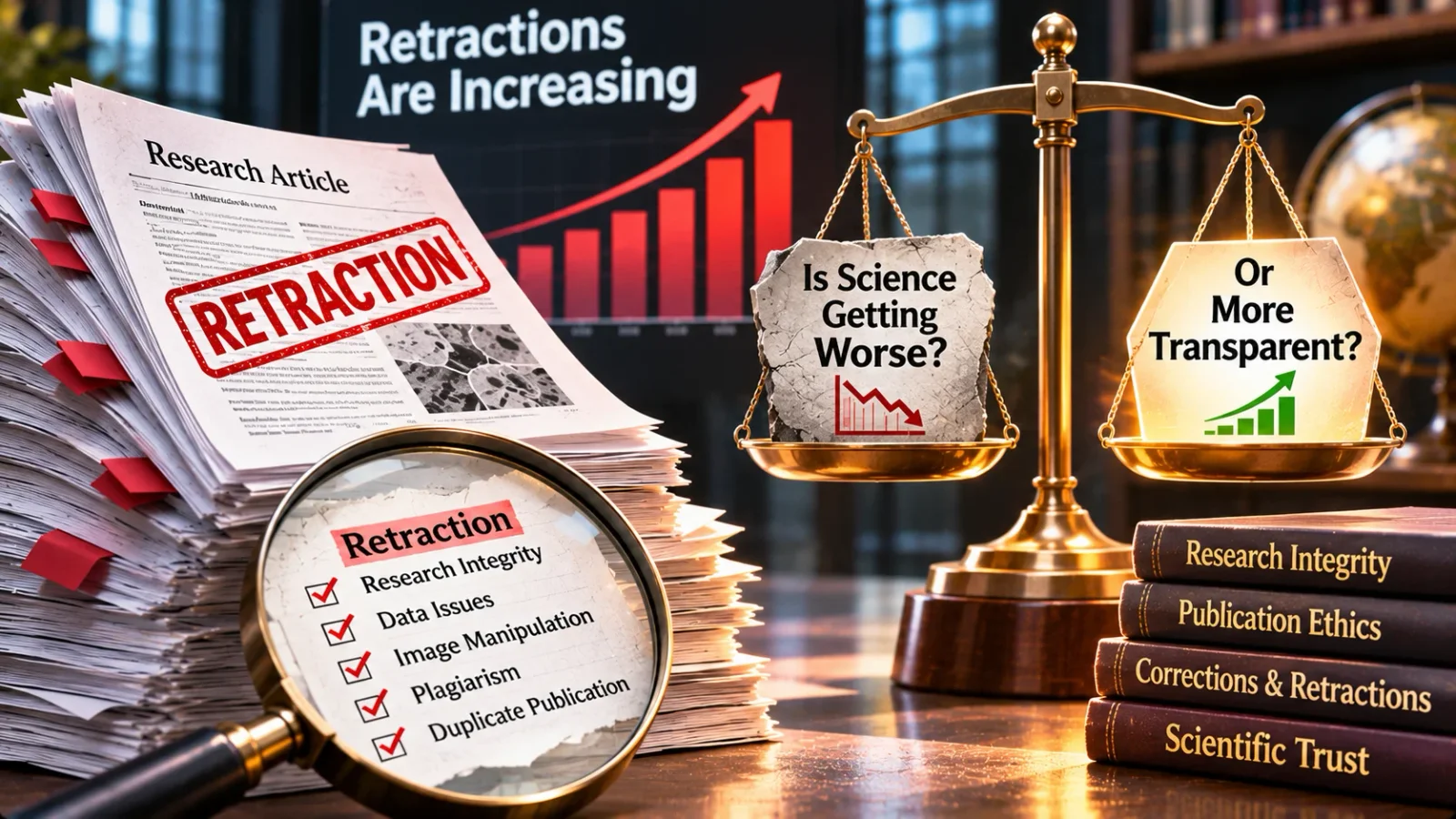
The evidence. The Barcelona Declaration on Open Research Information, published on 16 April 2024 with more than 30 initial institutional signatories, commits research performers, funders and evaluators to make openness the norm for the research information they use and produce. Sorbonne University, a signatory, had already announced in December 2023 that it would end its Web of Science and Clarivate bibliometric subscriptions in 2024 and work with the open database OpenAlex instead. On the integrity side, Crossref acquired the Retraction Watch database in September 2023 and made it openly available, giving reference-checking tools a common source for retraction data.
Implications. As institutions and funders build assessments on open data sources, the quality of the metadata a publisher deposits with Crossref, including ORCID iDs, ROR affiliation identifiers, funder information and retraction notices, directly shapes how its journals and authors are counted and found. Incomplete metadata is becoming a visibility problem, not just a housekeeping one.
Limits. Open sources vary in coverage and data quality, and they depend on what publishers deposit. Proprietary databases such as Scopus and Web of Science remain central to many evaluation systems, and discovery in an open database is not the same as selective indexing.
3. Formal AI-use disclosure policies
What it is. Journals have moved from ad hoc statements about generative AI to structured disclosure requirements built into submission workflows.
The evidence. The ICMJE recommendations now state that journals should ask authors at submission whether they used AI-assisted technologies, that authors should describe how, and that AI tools should not be listed as authors because they cannot take responsibility for the work. In September 2025 the STM association published recommendations for classifying AI use in manuscript preparation, setting out nine categories of activity, from text generation to data visualisation, intended to help publishers write their own disclosure policies rather than impose a single rule.
Implications. A shared vocabulary for AI use makes declarations more consistent across journals and easier for editors to assess. Publishers will need submission systems that capture these declarations as structured data and editorial guidance on what each category means for acceptance.
Limits. Disclosure depends on honesty and on authors understanding the categories. Policies differ between publishers, and the STM classification covers manuscript preparation only, not the use of AI in the research itself.
4. Publish, review, curate
What it is. In this model, research is shared first as a preprint, reviewed in the open, and then evaluated or curated, rather than being held back until a journal accepts it.
The evidence. eLife moved to this approach in 2023: it no longer makes accept or reject decisions after review, publishing reviewed preprints with public reviews and an editorial assessment of significance and strength of evidence. cOAlition S set out a broader vision in its October 2023 proposal, Towards Responsible Publishing, arguing that authors should control when and what they share and that the scholarly record should include peer-review feedback.
Implications. For publishers, this shifts value from the gatekeeping decision towards the quality and transparency of review and assessment. It requires platforms that can display versions, reviews and assessments as linked parts of one record.
Limits. The eLife experience shows the friction with established metrics. In November 2024 Clarivate told eLife it would no longer be covered in the Science Citation Index Expanded and would instead be partially indexed in the Emerging Sources Citation Index, meaning no Journal Impact Factor in the June 2025 release. eLife reported falling submissions from some countries where the metric weighs heavily, even as it said total papers sent for review held steady. For more on metrics, see our analysis of how the Impact Factor is used.
5. Licensing content to AI developers
What it is. Publishers have begun licensing access to their content and metadata to technology companies developing AI systems, creating a new revenue line.
The evidence. In July 2024, Informa reported that its Taylor & Francis division had an AI partnership with Microsoft and a second, unnamed agreement, and The Bookseller reported that the business expected around £58m in AI revenue that year. Wiley later reported $23 million in AI licensing revenue in fiscal 2024 and $40 million in fiscal 2025. Rights are also being stated in metadata itself: Elsevier's Crossref records, for instance, link to a text-and-data-mining licence and carry a notice reserving rights over uses including AI training.
Implications. Clear rights metadata, clean structured content and documented author agreements have become commercial assets as well as operational ones. Publishers considering such deals need to decide how they treat author and society interests, and how they communicate the terms.
Limits. Deal terms are usually confidential, partners are often unnamed, and author reaction has been mixed; The Bookseller reported in August 2024 that Wiley had confirmed there was no opt-out for authors. Whether these payments become recurring income or remain a short-lived wave of one-off deals is not yet clear, so publishers should be cautious about building plans around them.
What ties them together
None of these trends is primarily about a new gadget. Each depends on publishers producing well-structured content and accurate metadata, taking part in shared infrastructure, and making policies explicit enough to be applied consistently. Publishers that invest in those foundations will be able to respond to whichever of these developments matters most to their journals. Those that do not will find that integrity screening, open metadata, AI disclosure, new review models and licensing all expose the same gaps.